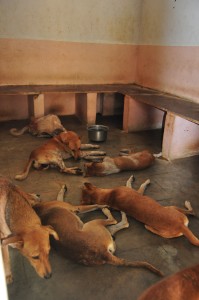
Cattle Rescue Project

The Importance of Cattle in India

To view more pictures, click here.

According to the Animal Laws in India, cows cannot be slaughtered. (See animal laws) Slaughtering cows is slaughtering the economy of the country. The practice of slaughter is extremely cruel and a disaster for the community and its agriculture-based economy.

Originally, in India, milk was not the most important product from the cattle. Cows and bulls were used in fields and their dung and urine were used to make compost, medicine and other health products. Only the little extra milk left from the cow after feeding her calf was used by the family who owned the cow. The cow was not yet considered a “milk producing machine”.

What has gone wrong?

At present the cows/cattle are reduced to production units of milk and meat. Cow slaughter is more and more accepted and practiced in spite of it being illegal in India.

From the 1950s, fertilizers and pesticides were introduced in India mainly for commercial crops like cotton and chilles. Because of the abuse of the soil with chemical fertilizers and pesticides the soil has lost its fertility and now agriculture has become unprofitable for farmers.

Because of drought and unprofitable agriculture, the farmers are encouraged to send their animals for slaughter. They go for cash crops from genetically modified seeds and are forced to use fertilizers and pesticides. They are also encouraged by the government to raise sheep for profit.

The government sponsored schemes for the welfare of the poor are encouraging the cross breeds through artificial insemination of cows and buffaloes for higher milk production.

Unfortunately, the high yielding crossbreed cows/buffaloes are vulnerable to fertility problems and diseases. Invariably, they end up in slaughterhouses. The male calves from the cross bred cattle are useless for draught purpose. They are deprived of their mother’s milk, starved to death or they go for slaughter. Also the cow is injected with Oxitocin to force maximum milk as fast as possible. Every milking results in labour pains, due to this drug, and the animal is traumatized. It is also regularly pumped with vaccines, hormones, antibiotics and other drugs.

Our aim is to restore the partnership between humans and cows

Our long-term objective is to put an end to all slaughter of cows and cattle and to improve the conditions of local farmers through sustainable agriculture/organic farming and the use of all cow related products.

Cattle Markets:

Cattle Rescue Project
To view more pictures, click here.

In our rural area there are three cattle markets where all laws regarding loading and treatment are flouted/neglected. Overloading of trucks with cattle for slaughter happens within the premises of cattle markets. The loading is extremely cruel. No action is taken by the police.

Action taken by our organization at the cattle markets is answered by threats to our lives.

There is a vicious circle of reproduction/breeding and slaughter in which the farmers and the animals are losers; the slaughterhouses and the “powers that be” are the winners.

The consequences of the above are the loss of indigenous cattle wealth, which are drought and disease resistant, very useful for agricultural work and the production of valuable uncontaminated manure for compost and many byproducts. Slaughter can be completely avoided.

Our history in cattle rescue:

  • Since 2002, Karuna Society has rescued over 500 cattle from illegal transport to slaughterhouses.
  • Since 2003, more than 200 rescued working bulls have been given for adoption to the local farmers under strict legal conditions.
  • We stopped the illegal cattle market at Gorantla, where there was no responsible authority. The market had turned into a centre for all illegal cattle trade and cruelty. We had to pay for these actions by an attack on our lives.
  • The High Court has given permanent custody of 305 cattle rescued by Karuna Society. The remaining cases are under trial.

Our difficulties:

  • Although we have rescued approx. 500 individual animals, structurally nothing has changed. A vicious circle exists consisting of production of new animals for milk and meat. Loss incurred due to the confiscation of cattle is made up by the butchers by raising prices.
  • As we are living in a drought prone area, maintenance of our rescued cattle during the drought is virtually impossible.
  • No support comes from the government for rescued cattle although they are government property, by law.
  • The new market has not improved as promised by the market management. Overloading and sale of cows for slaughter continues.
  • The threats to our lives from butchers and brokers continue.
  • There is no political will to implement the cattle preservation laws.
  • Widespread corruption cannot be discussed.

To initiate the change!

Preservation of the Indian Cow:

To encourage breeding of local species like Ongole Bulls, indigenous cattle breeds those are useful under local conditions for sustainable agriculture. Using local breeds can be completely slaughter free.

Our Actions:

  • Rescue of cattle from illegal transport to slaughter, insisting on improvements in the cattle markets.
  • Proper medical care of sick and injured cows/cattle to prevent them from being sent for slaughter (see under hospitals).
  • To encourage the use of Bio-gas units and production of compost. This makes every unproductive animal productive.
  • Extending our organic farm activities to create profit to maintain our rescued cattle.
  • Convert waste land into fodder/grazing areas for food, thus providing security in times of drought.
  • We have to prove to the farmers that it is possible and profitable to respect and care for cattle till the end of their natural life.

Our cattle and organic farming:

Since 2004, Karuna Society sells organic vegetables and raw milk products in its shop at Puttaparthi.

Now in 2008, we see that the profit made by the little produce is not enough to maintain our cattle and we are not utilizing our cattle byproducts fully. We have therefore decided to extend our production in a big way to enable us sell in bulk the organic produce to health food stores, restaurants, etc. all over India. The small shop in Puttaparthi will continue to serve the visiting foreigners daily with fresh vegetables, grains and raw milk products. (See shop)

Normally, certified organic produce is not necessarily cruelty/slaughter free, because nobody thinks about the source of the compost and urine used for natural fertilizer and pesticide. Manure and urine taken from local farmers or dairy farms is certainly not cruelty free nor slaughter free and most probably contaminated with hormones, antibiotics and adulterated feed residue.

Our organic produce is not just organic but it has the additional value of animal welfare and slaughter free products.

The origin of the Indian “Holy Cow” becomes crystal clear in this context and also shows the meaning of ‘sathwic’ food, which provides physical, mental and spiritual well being.